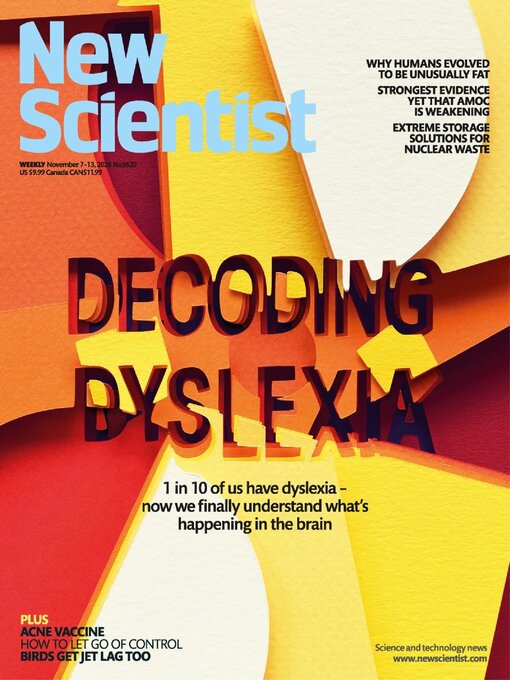
 Nov 07 2026
 Oct 31 2026
 Oct 24 2026
 Oct 17 2026
 Oct 10 2026
 Oct 03 2026
 Sep 26 2026
 Sep 19 2026
 Sep 12 2026
 Sep 05 2026
 Aug 29 2026
 Aug 22 2026
 Aug 15 2026
 Aug 08 2026
 Aug 01 2026
 Jul 25 2026
 Jul 18 2026
 Jul 11 2026
 Jul 04 2026
 Jun 27 2026
 Jun 20 2026
 Jun 13 2026
 Jun 06 2026
 May 30 2026
New Scientist covers the latest developments in science and technology that will impact your world. New Scientist employs and commissions the best writers in their fields from all over the world. Our editorial team provide cutting-edge news, award-winning features and reports, written in concise and clear language that puts discoveries and advances in the context of everyday life today and in the future.
Ditching dyslexia • Labelling children can provide them with support, but what about the rest?
Stage is set for another COP flop
Curiosity may drive brain complexity • Our ability to be curious may be what shapes our sophisticated brain architecture, rather than it being a consequence of this complexity, finds Jo Marchant
Key oddity of quantum physics may run even deeper than anticipated
A thick, rusty crust may have made Mars warm and wet
Computer science shaken by AI • A central assumption in computer science has apparently been disproven by OpenAI, a result that will force textbooks to be rewritten if confirmed, finds Chris Stokel-Walker
Satellites show weakened AMOC • An analysis of how much heat the ocean is releasing to the atmosphere adds to the evidence that the crucial Atlantic current system is slowing, finds Alec Luhn
Editorial
Stone determined where early humans made their homes
CO2 restarts ability to regrow tissue
Macaques don't see the world like humans do
Aerogels may solve insulation woes • Old homes across Europe are guzzling energy from poor insulation. Start-ups are turning to aerogels to help countries meet their net-zero goals, reports Madeleine Cuff
News
Views Columnist • On the mind During pregnancy, maternal cells can set up home in the brain of the fetus. Helen Thomson explores how these microchimeric cells may influence brain development and health
Views Columnists
Breaking up
Getting out of control • We have become addicted to dictating every event in our lives, argues a thought-provoking book, and this is making us unhappy.
Views Culture • Denis Villeneuve’s first (and probably best) foray into science fiction, Arrival, was released 10 years ago this month. It has hardly aged and is as staggering as it ever was, says film columnist Bethan Ackerley
Views Your letters
Decoding Dyslexia • We are finally pinning down what makes dyslexic brains different, opening up new ways to support those who struggle with reading, finds Kate Douglas
Burying danger • What should we do with all our nuclear waste? George Bass and Jacklin Kwan look into some extreme storage solutions
"Fat played an incredibly important role in our evolutionary history, which is one of the reasons we love it" • We have an unprecedented choice of food, yet our diets are worse than ever. Palaeoanthropologist Daniel Lieberman tells Sophie Berdugo what evolution can teach us about how to eat better
The back pages Almost the last word
The back pages Feedback